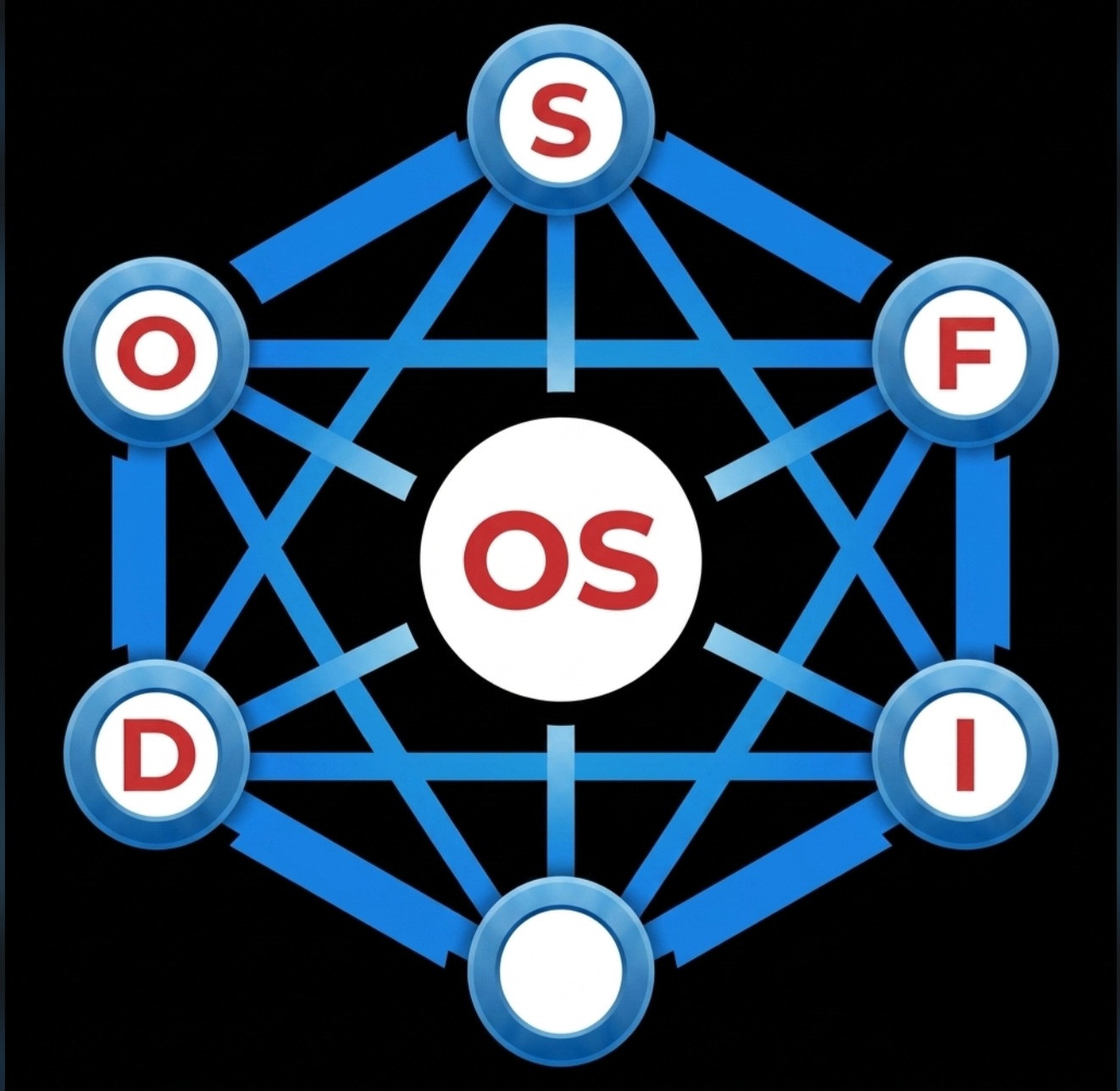
A sealed core. A published surface. A global runtime.
DOSFI is the operating system that orchestrates the mesh. MeshInfer.AI is the runtime that executes the workloads. Below the ABI boundary, the engines are proprietary; above it, the ecosystem builds freely.
The OS that schedules. The runtime that executes.
DOSFI sits between intent and the mesh. It accepts a workload, partitions it, scores node readiness, routes shards, and verifies results — all without a central data center. The MeshInfer.AI runtime executes each shard on-device, optimizing and verifying inference across the fabric.
Each layer is a foundational component of the DOSFI stack.
ENGINE_01
Closed-Source Scheduler
The proprietary brain of DOSFI. It partitions massive workloads into shardable units and assigns them to the most capable nodes in real time, continuously rebalancing as the mesh shifts.
ENGINE_02
Routing Engine
Determines the optimal path for every shard across the mesh, minimizing latency and hops while honoring privacy tiers and trust boundaries.
ENGINE_03
Readiness Engine
Continuously scores every node on availability, thermal headroom, battery, and trust — so only truly ready devices receive work.
MODEL_01
Privacy Tiers
Workloads are classified and matched to nodes by sensitivity. Higher tiers are confined to stricter isolation and verified execution environments.
MODEL_02
Power / Thermal Model
DOSFI respects each device. The power and thermal model caps utilization to protect hardware, battery life, and the human using it.
SEC_01
Zero-Trust Execution
No node is trusted by default. Every shard is isolated, attested, and verified before, during, and after execution.
SEC_02
Post-Quantum Encryption
Every link and payload across the mesh is protected with post-quantum cryptography, future-proofed against quantum adversaries.
How DOSFI handles security differently — at every layer.
Standard server security relies on a trusted perimeter that crumbles the moment an attacker gets inside. DOSFI's zero-trust mesh verifies every node, shard, and result — cryptographically, continuously, and with no assumed trust.
Filter by category
Standard Server
Perimeter-based security model
DOSFI Zero-Trust
Verify-everything mesh architecture
Trust Model
Default Trust Stance
Implicit trust inside perimeter
Any node inside the network is trusted by default
Zero trust — verify everything
Every node, shard, and link is attested before use
Trust Model
Node Authentication
IP / subnet-based identity
Lateral movement exploits static identity boundaries
Cryptographic attestation per execution
Hardware-rooted identity verified on every task
Execution
Shard Isolation
Shared process / VM space
Co-tenancy risks data leakage across workloads
Isolated execution per shard
Each compute shard runs in a sealed, verified environment
Execution
Result Verification
Trust-on-return — no verification
Corrupted or tampered results pass through undetected
Cryptographic result attestation
Every result is signed and verified before acceptance
Encryption
Data-in-Transit
TLS 1.2 / 1.3 (classical)
Vulnerable to harvest-now-decrypt-later quantum attacks
Post-quantum encrypted mesh links
All links use NIST-standardized PQC algorithms
Encryption
Data-at-Rest on Node
Often unencrypted or AES-256 only
Keys may reside on the same compromised host
Encrypted, node-local, ephemeral
Payload never persists beyond shard lifetime
Access Control
Privilege Model
Broad admin roles, static ACLs
Over-privileged accounts are the #1 breach vector
Least-privilege per shard / task
Permissions scoped to exact compute unit, no more
Access Control
Lateral Movement Risk
High — flat internal networks
Compromise of one host propagates freely inward
Near-zero — microsegmented mesh
Nodes cannot address each other outside routed tasks
Monitoring
Audit Trail
Centralized, mutable log store
Logs can be altered by a compromised server
Immutable distributed attestation log
Every execution event is cryptographically chained
Monitoring
Real-Time Threat Detection
Perimeter-only sensors
Blind to threats that bypass the edge
Per-node continuous health scoring
Anomalous nodes are de-scored and excluded instantly
DOSFI passes 10/10 security controls
Standard servers pass 0/10 security controls
Why distributed wins — by every measure.
Centralized compute was built for a world where servers were scarce. DOSFI treats every idle device as a first-class compute node — delivering higher throughput, lower cost, and better resilience than any single data center ever could.
Normalized capability scores (0–100) across seven architectural dimensions. Higher is better in all categories.
How much compute is sitting idle in your device fleet right now?
MESH_CAPACITY / ESTIMATOR
Distributed Compute Estimator
Enter your device counts to estimate the ambient compute capacity DOSFI could orchestrate across your mesh. Assumes ~40% average idle availability per device.
Active Nodes
1,700
devices
Distributed Compute
2.2K
TFLOPS
Equiv. GPUs
225
RTX 3090 equiv.
Tasks / Sec
3.1K
est. capacity
Estimates only · DOSFI scheduler + MeshInfer.AI runtime · Real capacity depends on readiness scores
The contract between the open ecosystem and the proprietary core.
Developers build ON the OS, not IN the OS.
The Application Binary Interface is the contract between the open ecosystem and the proprietary core. DOSFI exposes a stable, published surface — the Task, Node, and Routing APIs — while the scheduler, router, and runtime remain sealed behind it. You ship mesh-native apps against the ABI; DOSFI handles the orchestration, MeshInfer.AI handles the execution.
RUNTIME_01
Mesh-Native App Runtime
A proprietary execution surface where mesh-native apps run safely against the published ABI, sandboxed from the scheduler and router beneath them.
RUNTIME_02
Built ON, never IN
Developers ship apps and nodes against stable APIs. The orchestration core stays sealed — defensible, safe, and owned.