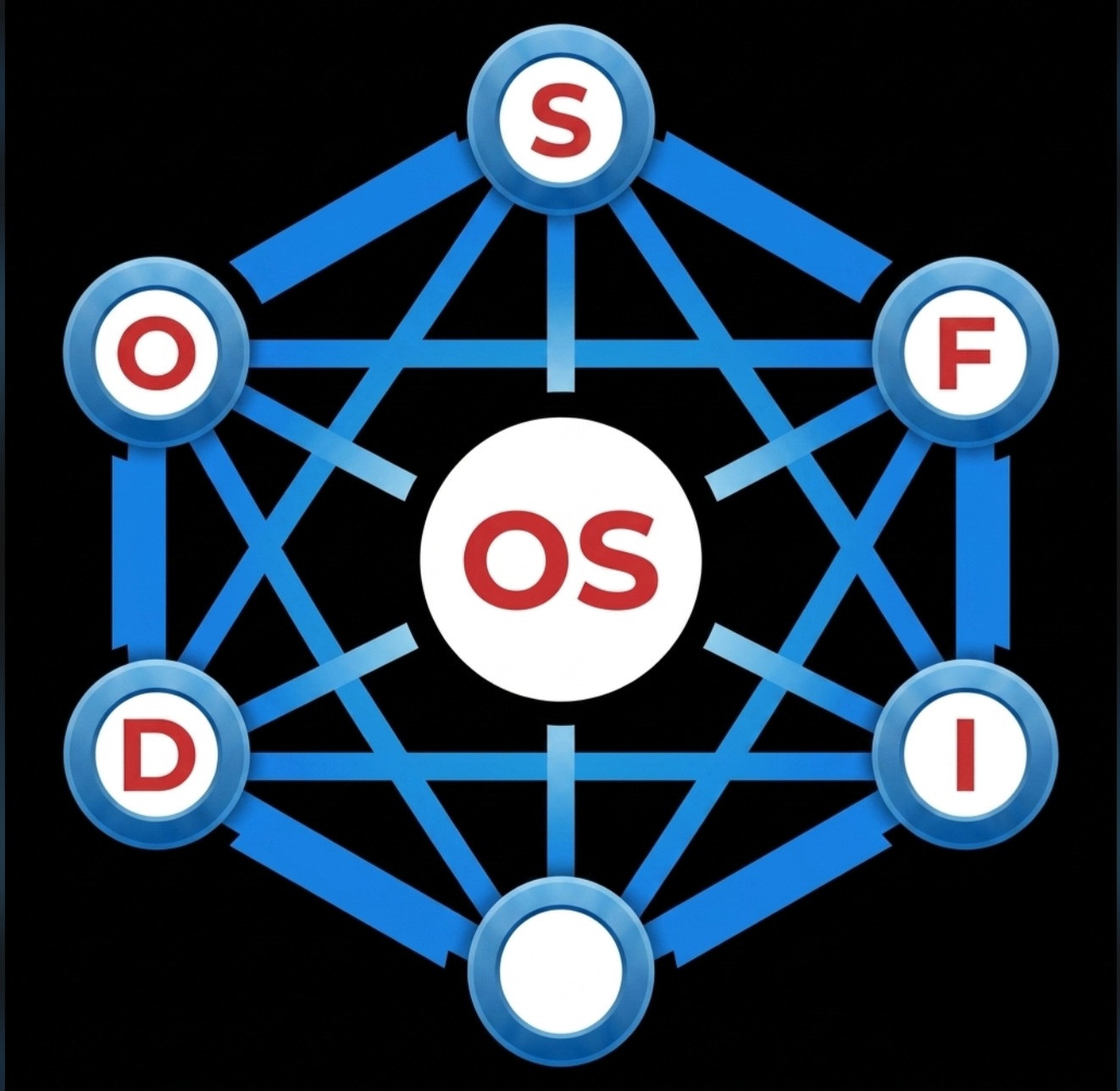
Starlink + DOSFI: Bypassing the Cloud
By using Starlink to shrink the physical network layer and DOSFI to move the computation to the browser or local edge node, you bypass the cloud altogether. You aren't just matching fiber speeds; for distributed AI workloads, you are fundamentally undercutting the physics of legacy internet routing.
“By using Starlink to shrink the physical network layer and DOSFI to move the computation to the browser or local edge node, you bypass the cloud altogether. You aren't just matching fiber speeds; for distributed AI workloads, you are fundamentally undercutting the physics of legacy internet routing.”
Legacy routing is physically suboptimal
Centralized cloud routing forces every workload to traverse a fixed backbone: user to ISP to regional data center to model endpoint and back. Each hop adds serialization, switching, and queueing latency that is structural to the topology, not the workload. The path length is dictated by where the data center happens to be, not by where the compute should be.
The cloud is a location, not a requirement
The cloud is an architectural assumption: that compute must live in a centralized facility and that data must travel to it. If the physical layer can reach any node directly and the intelligence layer can place compute on the nearest capable node, that assumption collapses. There is no workload that requires a data center — only workloads that have not been given a nearer alternative.
Undercutting the physics, not the price
Matching fiber speed is a throughput claim. Bypassing the cloud is a topology claim. When compute moves to the browser or local edge node, the number of network hops between the workload and its result approaches zero. You cannot optimize a path you no longer traverse. This is not a faster cloud — it is the removal of the cloud from the path.
The physical layer is the set of links a workload must traverse to reach compute. In a cloud model that set is long and terrestrial. Starlink collapses it by making the link direct, symmetric, and planetary.
Direct-to-node physical reach
Starlink's low-Earth-orbit constellation places the physical link within a single hop of the terminal. A node no longer depends on a terrestrial backbone to reach a regional exchange — the satellite is the exchange. The physical layer shrinks from a multi-hop terrestrial chain to a single uplink-downlink pair.
Symmetric, low-latency backhaul
Legacy routing is asymmetric: download is optimized, upload (the direction inference results and shard outputs travel) is constrained. Starlink provides symmetric backhaul at low latency, so a node that produces compute output can return it as efficiently as it receives input. The physical layer stops penalizing the return path.
Coverage replaces proximity
In a cloud model, latency is a function of distance to the data center. In a Starlink-extended model, latency is a function of distance to the nearest terminal — which is, increasingly, everywhere. Proximity to a central facility is replaced by coverage of the planetary surface. The physical layer no longer constrains where compute may live.
The compute layer is the set of facilities where workloads execute. In a cloud model that set is a small number of centralized data centers. DOSFI collapses it by governing every Node — including the browser and local edge node — as a first-class execution target.
Compute moves to the nearest capable Node
DOSFI's Scheduler and Routing Policy place each workload on the nearest Node that satisfies its capability, privacy, and attestation requirements — including the browser or local edge node that issued it. Compute does not travel to a data center; the data center is dissolved into the mesh. The compute layer shrinks from a remote facility to the device in front of the user.
Identity Fabric and Privacy Tier enforcement
Moving compute out of the cloud requires that every Node be governed as rigorously as a data center would be. The DOSFI Identity Fabric binds each Node to an @dosfi.ai identity, hardware-attested and cross-verified. The Tier 0–Tier 5 Privacy Model classifies each transfer. A browser or edge node is not a downgrade in trust — it is a governed participant.
Transport Layer and Bundle Schema
The DOSFI Transport Layer wraps every transfer in a policy-bound, attested envelope. The Bundle Schema defines the workload as a typed, signed, versioned contract — model, shard, input, output, privacy tier, settlement terms. Workloads execute at the edge under the same governance contract they would have had in the cloud, without the cloud's topology tax.
Vital DIU economics and MNE settlement
A cloud bills for compute as a rental. DOSFI settles compute as a metered credit: each verified shard emits a Distributed Intelligence Unit (DIU) event, reconciled through MeshNativeExchange (MNE). A Node that performs work earns; a submitter spends. Economics no longer require a central intermediary — they are settled peer-to-peer across the mesh.
The cloud leaves the path
Starlink removes the terrestrial backbone from the physical path. DOSFI removes the data center from the compute path. With both layers collapsed, there is no remaining hop that a centralized cloud must occupy. The workload originates at the edge, executes at the edge, and returns to the edge — the cloud is not bypassed by speed, it is bypassed by topology.
A mesh-native planetary stack
The result is a Mesh-Native network in which the physical layer is planetary, the protocol layer is distributed, and the intelligence layer is governed at the edge. The Workflow and State Machine execute across Nodes that are identity-bound, privacy-tiered, and policy-routed. There is no cloud in the loop — only the mesh, governed by DOSFI, settled by Vital, validated by MeshInfer.