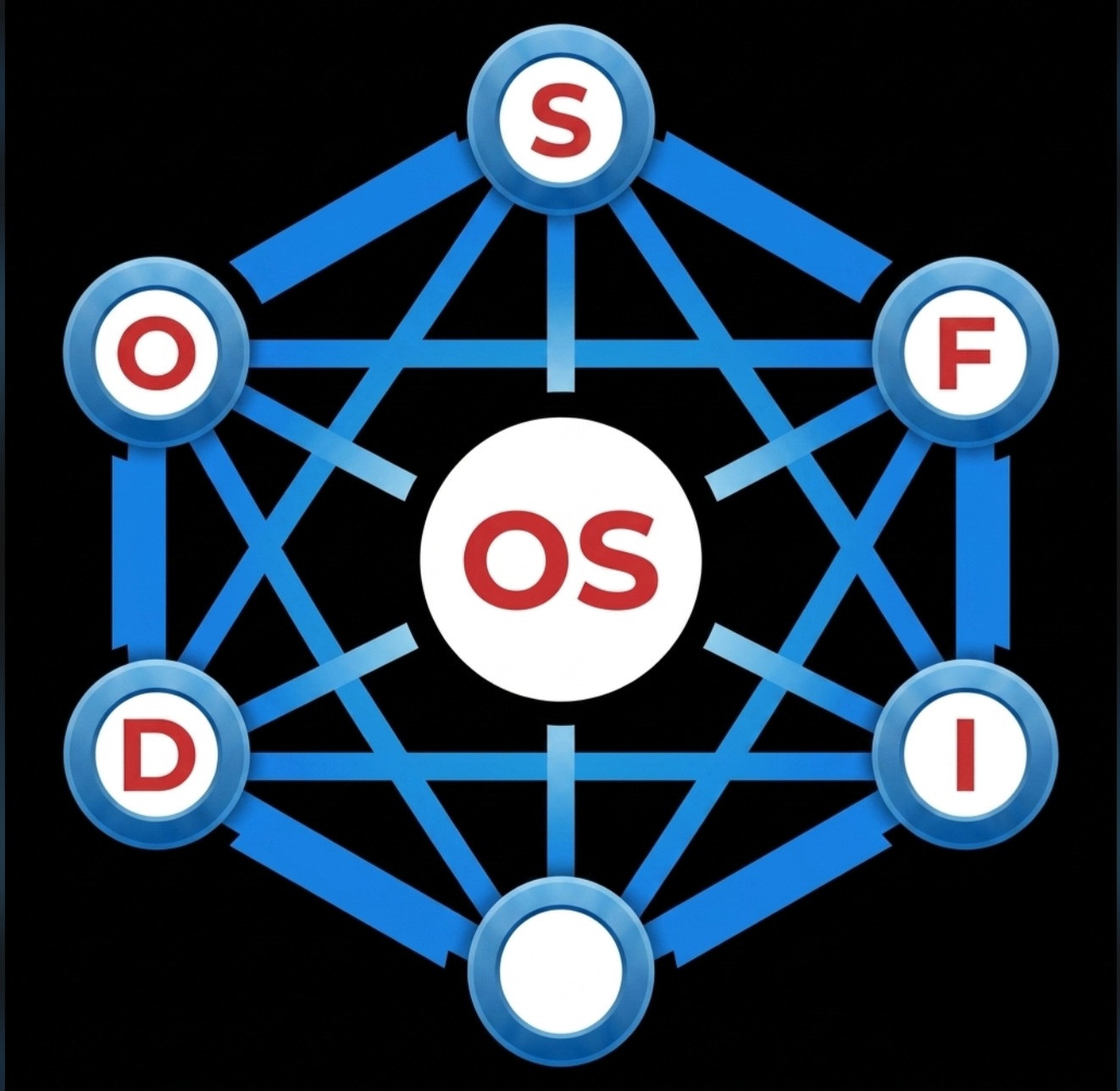
How DOSFI works — layer by layer.
A complete technical reference for the DOSFI distributed operating system: its layered stack, scheduler lifecycle, privacy tier model, distributed storage, and the ABI boundary that separates the open ecosystem from the sealed core.
Five layers. One unified OS.
DOSFI is organized as a strict layered architecture. Developers interact exclusively above the ABI boundary. The orchestration core is sealed and operated by DOSFI.
Application Layer
Mesh-native apps, DOSFI Studio, external SDKs, and third-party integrations. Developers build here — exclusively above the ABI boundary.
ABI Boundary
The stable, versioned contract separating open developer surface from the proprietary core. Developers write against the ABI; the OS implements it.
Orchestration Core (Sealed)
Closed-source engines that power the OS: the scheduler, routing engine, readiness engine, and privacy enforcement layer. Not accessible to third parties.
Runtime Layer
The MeshInfer.AI runtime executes inference shards on-device. Each node runs an isolated execution environment with attestation and verification.
Node & Transport Layer
Raw device compute, peer-to-peer mesh transport, and post-quantum encrypted channels. Heterogeneous devices from mobile to server-grade hardware.
From task submission to verified result.
Every workload follows a deterministic six-stage lifecycle through the DOSFI scheduler. Each stage is independent, observable, and fault-tolerant.
Workload Ingestion
A developer submits a task via the Task API. DOSFI validates the payload, infers the privacy tier, and queues it for partitioning.
Shard Partitioning
The scheduler decomposes the workload into the minimum viable set of shards — balancing granularity against coordination overhead.
Node Scoring
The readiness engine scores every eligible node in real time: battery, thermals, bandwidth, trust tier, and available VRAM or CPU headroom.
Routing Assignment
The routing engine matches shards to nodes, enforcing privacy tier constraints, geographic restrictions, and operator-defined policies.
Execution & Verification
Nodes execute shards via the MeshInfer.AI runtime. Results are attested, cross-verified across redundant nodes, and aggregated.
Result Delivery
Verified results stream back to the caller via the Task API event stream. The task is marked complete and metered for Vital settlement.
Sensitivity-matched compute routing.
DOSFI classifies every workload into one of six privacy tiers. The router enforces tier constraints automatically — developers declare intent, the OS enforces it.
Public
No routing restrictions. Any consenting node may participate. Suitable for non-sensitive workloads and benchmarking.
Requirements: Any registered node
Tier-1
Nodes must pass identity verification and maintain a minimum trust score. Data is encrypted in transit.
Requirements: Verified identity + trust score ≥ 80
Tier-2
Restricted to geo-compliant nodes within operator-declared jurisdictions. Post-quantum encryption on all shards.
Requirements: Geo-compliant + PQ encryption + operator policy
Tier-3 Sealed
Hardware-attested execution environments only. Shards never leave isolated enclaves. Enterprise-grade compliance.
Requirements: Hardware attestation + enclave execution + Enterprise plan
Tier-4 Sovereign
Enterprise-controlled mesh nodes only. Custom routing policies, dedicated capacity, and operator-managed key escrow. Suitable for regulated industries with data sovereignty requirements.
Requirements: Enterprise mesh + custom routing policy + operator key escrow
Tier-5 Classified
Air-gapped or dedicated hardware enclaves with multi-party attestation. Government-grade compliance. Maximum isolation and audit requirements.
Requirements: Air-gapped enclave + multi-party attestation + classified compliance
State that lives across the mesh.
DOSFI does not rely on a central database. Application state is sharded, encrypted, and replicated across participating mesh nodes — consistent with the same privacy tier rules as compute.
Distributed State
Application state is sharded and replicated across the mesh with configurable consistency guarantees. No single node holds the full state.
Encrypted-at-Rest
All persisted state is encrypted with per-shard keys derived from the node's attested identity. Keys are never stored alongside data.
Consistency Model
DOSFI uses eventual consistency with conflict-free replicated data types (CRDTs) for most state. Strong consistency is available for Tier-3 workloads.
State Routing
The routing engine applies the same privacy tier rules to state retrieval as it does to compute shards — ensuring data locality compliance.
Every node has a cryptographic identity.
DOSFI assigns a hardware-bound identity to every participating node at provisioning. This identity anchors routing policy, trust scoring, and privacy tier eligibility.